
Disclaimer: This is an opinion piece, not investment advice. The views are my own, and do not reflect the views of my clients or students.
Is this the end of the AI bubble, the biggest and most beautiful bubble I have seen in my adult lifetime? It certainly feels like we’re already in the midst of the first big cracks. And if history is any guide, the way down will be a lot faster than the way up.
A book, a daughter and a blood-bath
Last month, just a few days after we celebrated her 20th birthday, my youngest daughter asked me about my favorite finance books. That conversation led her to suggest we read John Kenneth Galbraith's The Great Crash 1929 together, one of several books I had mentioned to her.
Of course, I had no idea at the time that the stocks riding the AI chip and datacenter spending boom would get battered the way they have, less than a month later. Turns out Mr. Market had read ahead! The Nasdaq 100 was already more than 10% off its October 6 peak by November 3. Then, on November 5, the S&P 500 fell more than 3% in a single morning as the AI trade unraveled. CoreWeave dropped about 15% that day. Over the past month Dell is down roughly a third, Super Micro about 32% and Micron about 26%. Intel had its worst single day in more than four decades.
Yet the day after the midterms (the US congressional and state elections), Microsoft rose 6.7% and Amazon 6.1%, while Vistra fell 13.8% and Vertiv 12.9%. In Seoul, foreigners sold ₩3.4 trillion [~US$2.6 billion] of Korean stocks, the fifth straight day of selling. The market sold anyone who has to build and bought anyone who owns or uses. The selling is aimed squarely at the companies whose next few years depend on AI spending continuing at today's pace. And isn't that exactly where a bubble should crack first?
I have covered markets since 1997, starting with the dot-com boom in San Francisco, and I’ve lived through the 2000, 2008 and 2022 sell-offs up close. Believe me, this AI capex (the enormous sums spent on datacenters, chips and power) bubble feels like the biggest of my lifetime. And the perhaps not-so-random book my girl picked for us reads like a field guide to it!
Why it’s the biggest one
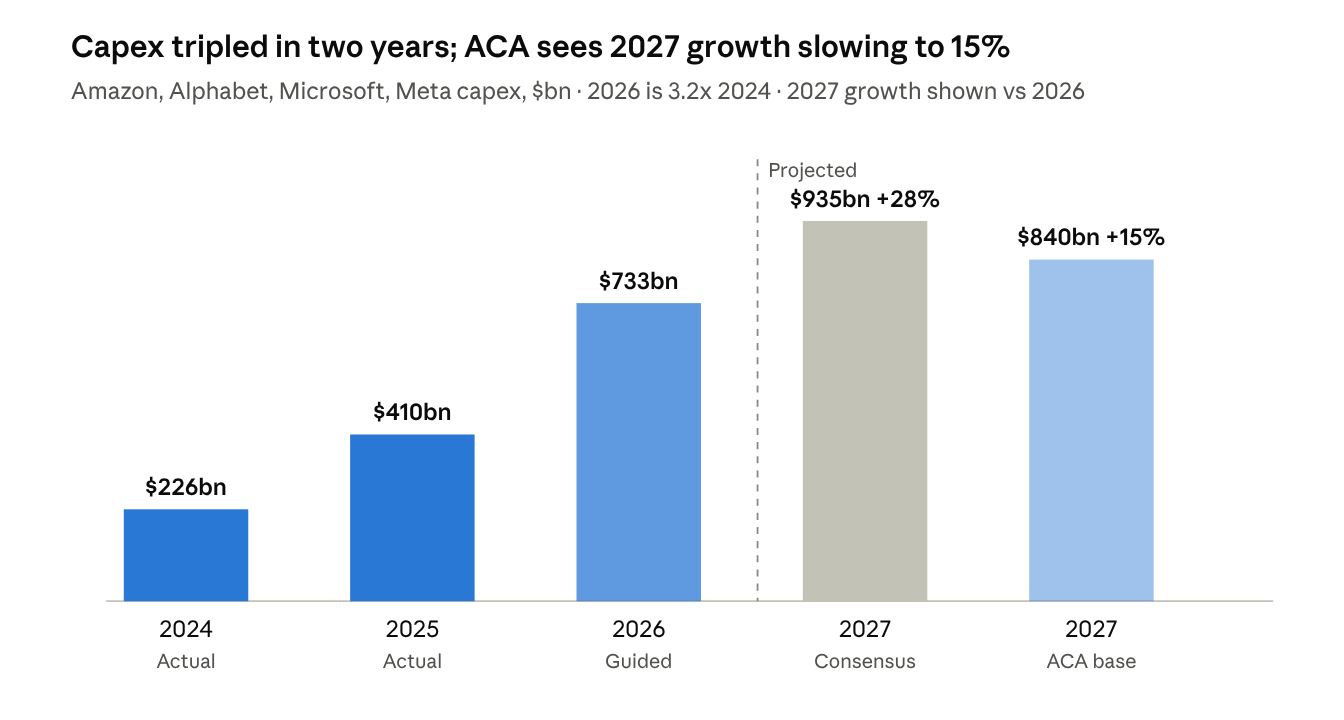
First, the spending. Amazon, Alphabet, Microsoft and Meta have guided to roughly $720–745 billion of capex for 2026. That is up from about $410 billion in 2025 and about $226 billion in 2024, so it has more than tripled in two years. None of them has cut their 2026 plan. Alphabet's CFO said on the October 28 call that capex will "increase significantly in 2027". Amazon said on October 29 it expects to "spend meaningfully more in 2027". Before the election, consensus had big-four capex at $935 billion for 2027, up another 28%.
Second, the cash is running out before the ambition does. In the third quarter Alphabet's capex hit about 121% of its operating cash flow, leaving free cash flow negative by about $9 billion. Meta's free cash flow turned negative too, at minus $2.1 billion. These were the greatest cash machines in corporate history. They are now funding the build-out with bonds, leases and off-balance-sheet vehicles.
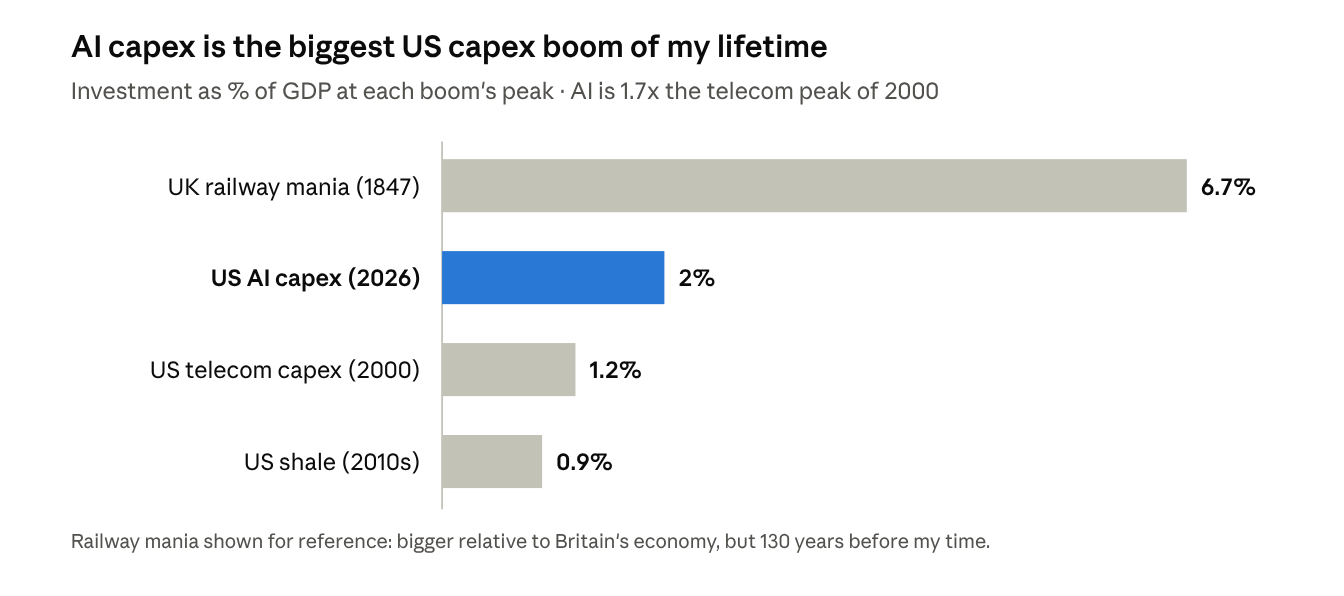
Third, the whole economy is leveraged to it (if you'll pardon the pun). AI investment is running at close to 2% of US GDP this year. The St. Louis Fed (one of the 12 regional banks of the US Federal Reserve) estimated that AI-related investment drove about 39% of real GDP growth in the first nine months of 2025. In 2000, at the dot-com peak, IT investment drove 28%. The ten largest stocks make up around 40% of the S&P 500, against 26.6% at the 2000 peak. Yet they earn only about a third of the index's profits.
To be fair, Britain's railway mania was bigger relative to its economy: railway investment reached 5.7–6.7% of UK GDP in 1846–47. But nothing in my own lifetime comes close. The dot-com era's telecom capex peaked at about 1.2% of GDP. On spending, concentration and dependence, this cycle is in a league of its own.
The anatomy, as Galbraith drew it
I learned five key lessons from Galbraith’s book, and each has a mirror image in 2026.
One - leverage stacked on leverage. In late 1928 Goldman Sachs launched the Goldman Sachs Trading Corporation, which then sponsored Shenandoah and Blue Ridge, trusts that bought into each other. The structure magnified gains on the way up and wiped out holders on the way down. Today’s version—bear with me, this one gets a little tricky—is the datacenter special purpose vehicle, or SPV (a separate company that holds the building and its debt, off the tech giant's balance sheet). A hyperscaler (one of the giant cloud operators: Amazon, Microsoft, Alphabet and Meta) signs a lease, a private-credit fund (a non-bank lender, usually run by an asset manager) lends against it, and the loans get pooled and sold on to insurers and pension funds. AI-related debt has passed $500 billion, and private credit alone holds more than $200 billion of loans to AI companies. The economist Hyman Minsky figured this out decades ago: the calm years are exactly what tempts everyone to borrow more, so stability ends up breeding the crash. In this case it was probably more just the mad rush for compute, but you get my meaning.
Two - money that goes round in a circle. In 1929, corporations lent their spare cash into the call-money market (overnight loans to brokers) to fund the speculators buying their own shares. In 2026, Nvidia invests in and guarantees the debts of the customers that buy its chips. Its announced deals have passed $750 billion, including talks over a $250 billion guarantee for an OpenAI datacenter in Ohio. Nvidia's credit default swaps (the price of insuring its debt against default) hit a record on the news. Supplier financing is normal business. At this scale, it makes demand look stronger than it is.
Three - the experts are always reassuring. Professor Irving Fisher of Yale said stocks had reached "a permanently high plateau" days before the 1929 crash. The Harvard Economic Society kept announcing recovery until it quietly closed. Our version is every capex bull who says the hyperscalers are "capacity constrained". So were the telecom carriers in 1999. WorldCom, Global Crossing and their rivals laid more than 100 million miles of fiber-optic cable (the glass strands that carry internet traffic) worldwide in just two years, because traffic was supposedly doubling every 100 days. It wasn't. By mid-2001, only about 5% of that fiber was in use; the rest sat unlit, or "dark". WorldCom and Global Crossing went bankrupt, and Corning, which made the glass, fell from about $113 a share to about $1. In a boom, every shortage is a glut in waiting. In 1999, the glut was made of glass.
Four - the organized rescue. On Black Thursday (24 October 1929), the heads of the big banks met at J.P. Morgan's offices. Richard Whitney, vice-president of the stock exchange, walked onto the floor and bid well above the market for US Steel. Thomas Lamont, a Morgan partner, called the selling "purely technical". The rally lasted barely a day. We should watch the "buy the dip" calls ahead of Nvidia's November 17 results in that light.
And five - the bezzle. Galbraith's best idea is the "bezzle": the stock of undiscovered embezzlement that grows in good times and shrinks in bad ones, when audits tighten. Whitney himself went to Sing Sing, the New York state prison, in 1938. Every boom hides its bezzle, from Insull to Enron, Wirecard and FTX. A sell-off is when we find out which AI revenue was arm's-length and which was manufactured.
The way down is faster than the way up
The Roman philosopher Seneca said it 2,000 years ago: things grow slowly, but ruin comes fast. History agrees. The Dow (the oldest US stock index) took more than five years to quadruple into September 1929. It lost about half its value in ten weeks, and 89% by July 1932. The Nasdaq took five years to climb from about 800 to over 5,000 by March 2000, then gave back 78% in two and a half years. Japan’s Nikkei nearly doubled in 1988 and 1989 alone, to its December 1989 peak of 38,916, then lost almost half its value in nine months.
Three mechanics make AI capex especially prone to a fast unwind
Suppliers live on the rate of change, not the level. Capex does not have to fall for Nvidia, Micron or the power and cooling names to suffer. It only has to stop accelerating. My view is that big-four capex will grow only about 15% in 2027, to roughly $840 billion, against the 28% consensus going into the midterms. And I fear even that may prove too optimistic, depending on how fast things unwind. The risks, I suspect, sit on the downside. Politics and public opinion do not have to kill a single project to get there. It only has to slow the newest ones. Even +15% is a sharp slowdown for a supply chain priced for +28%. Cisco never stopped selling routers after 2000, yet its stock fell about 90%.
The collateral wears out fast. Railway track lasted a century and dark fiber is still lit today. A GPU (graphics processing unit, the workhorse AI chip), on the other hand, can become economically obsolete within a couple of years as each new chip generation arrives. Companies depreciate them over five or six years, often well before the debt behind them is paid off. Lenders want asset lives that outlast loan terms, but GPUs break that rule. Much of the newer borrowing, at CoreWeave and its peers, is floating-rate, with the 10-year Treasury yield near 5%.
The same money is in everything. Passive funds hold the top ten at 40% weight. Private-credit funds, insurers and pensions own the datacenter debt. Retail investors own the leveraged single-stock ETFs (exchange-traded funds that deliver two or three times a single stock's daily move). Those are exactly the people who jumped in late. As the economic historian Charles Kindleberger put it, nothing messes with your judgment like watching a friend get rich. When all of them try to leave at once, there is no one on the other side. This is the proverbial tide going out and the market telling us who's swimming naked.
The 'canary in the coal mine' is an elusive bird. A crash trigger is rarely what the consensus hordes are watching for. In 1929 it was not a Fed hike but a slow pile-up of small breaks. Hemingway nailed it when he described going broke: gradually, then suddenly. This time the spark may be political. This week's midterm results raised the chance of datacenter moratoriums: New York imposed a one-year pause in July, and Texas paused approvals in August. About 75 projects worth roughly $130 billion were delayed or canceled in the first quarter alone. On election day, 80% of voters in Trenton, Ohio, backed a ban that blocks a 1,000-megawatt Amazon datacenter site, and datacenter limits passed in 14 of 18 Ohio towns.
What people may not be thinking about enough
Most commentary stops at "tech stocks fall". The second-order effects are where everyday people will feel the pain, and this, I fear, is not remotely priced in.
1. A recession led by the rich. By Moody's estimate the top 10% of earners now account for close to half of US consumer spending, up from about 36% thirty years ago. Fed survey data puts the share much lower, near 28–32%, so the true figure is debated. Either way, the spending that keeps the economy growing leans on the wealthiest households. The same households own about 93% of US stocks. When their portfolios fall 25%, they cut back on travel, restaurants, new cars and home renovations. The people who lose shifts and jobs are the waiters, contractors and dealership staff in the bottom 80%, who never owned much Nvidia.
2. Your "diversified" retirement fund isn't. A plain S&P 500 index fund or target-date fund puts about 40 cents of every dollar into ten stocks, most of them AI-linked. Millions of 401(k) savers have a concentrated tech bet they do not know about. Ten years after the March 2000 peak, the S&P 500 was still below its 2000 level. A 65-year-old retiree does not have that kind of time.
3. The electricity bill does not come back down. Residential power prices have risen about 42% in five years, and datacenter demand is one real driver. On the PJM grid (PJM Interconnection, the operator of the power grid and wholesale electricity market for 13 states from Illinois to Virginia, plus Washington, DC), the capacity price (what the grid pays power plants to stand ready for peak demand, passed on to every bill) jumped more than tenfold, from $28.92 per megawatt-day for 2024/25 to $329.17 for 2026/27, and every auction since has cleared at the price cap of about $325–333. Datacenters caused about 38% ($6.3 billion) of the $16.4 billion bill from the latest auction, held in July. Households are already paying for datacenters that do not exist yet. If the datacenters are canceled, the debt for that grid still must be paid, and households carry it. Ratepayers would pay twice: once for the boom, and again for the bust.
4. Retirees own the debt. Datacenter loans have been pooled and sold to insurers, pension funds and retail "interval funds" (funds sold to individuals that only allow withdrawals at set intervals). Private credit carries no bank-style capital requirements and marks its loans infrequently. A pensioner's annuity may be backed by a lease on a half-built GPU campus without anyone telling them.
5. Jobs and tax revenue in the boom towns. Datacenter construction hit a record annual rate of about $85 billion this summer. Electricians, steel workers and cement trucks in Virginia, Texas, Ohio and Georgia follow the capex line. So do the local property-tax bases and state budgets that rely on capital-gains tax receipts, California's above all.
6. The shock travels abroad. Korea, Taiwan and Japan are the factory floor of AI, through SK Hynix, Samsung, TSMC and Tokyo Electron. On November 5 the KOSPI (Korea's main stock index) fell 5.3% and SK Hynix 9.5%; at about 2.5 times forward earnings, Hynix is priced like a commodity, not a growth stock. Korea has become the AI-hardware ATM, the market foreigners sell when they need cash. An AI capex pause is an emerging-market export shock as much as a US one.
There is one honest silver lining. After 2002, cheap dark fiber gave the world Netflix streaming and AWS (Amazon Web Services, Amazon's cloud business), built by people who never laid a single cable. A glut of cheap compute after this bust could do the same for AI. The technology survives the bubble; many of its first investors may not.
What I am watching
It is early, and the bulls have their arguments: AI demand is real, Amazon and Alphabet say they are still short of capacity, and nobody has cut a 2026 budget. Every one of those was also true of fiber in 1999. Sir John Templeton, the great value investor, used to say the four most dangerous words in investing are "this time it's different". Bubbles do not end when the technology fails. They end when the money behind it stops believing in the return. These are some of the signals that would tell me the unwind is well and truly under way:
2027 capex guidance in late January, against the $935 billion consensus. Guides at or above it, with cloud growth speeding up, would prove me wrong. Even then, I’d look past the headline number to how much can actually be plugged in and finished.
Nvidia's November 17 results: the order book, and how much revenue it is financing itself.
Hyperscaler free cash flow and new bond and SPV issuance, and the spreads they pay.
Datacenter cancellations and moratoriums in the states after the midterms, and PJM's next capacity auction on December 22.
Private-credit marks and redemption gates (limits on investor withdrawals) in funds with datacenter exposure.
High-end consumer spending: luxury, travel and restaurant trends among the top 10%.
So yes, at the risk of sounding like Chicken Little in a falling market, this does feel like the first real crack in the biggest capex bubble of my lifetime. The spending may hold up for another year, but stocks trade the slope (how fast spending is growing), not the level (absolute dollars spent), and the slope has already turned. By 2028 the bill comes due: deferred projects, a higher cost per megawatt and supply contracts that do not protect price. There will be rallies along the way, and some will be violent. Still, I would rather be early than be Irving Fisher. Galbraith ended his book doubting we would ever learn; I just hope my daughter and I spot the plateau before it turns into a cliff.
Annapurna Capital Advisors. Views are my own and not investment advice.
Read on: The Anatomy of a Bubble, Part 2: The Reckoning (and the China Opportunity), published 19 November.
Sources
John Kenneth Galbraith, The Great Crash 1929 (HMH edition): Florida boom pp. 3–8; Goldman Sachs Trading Corp. pp. 61–62; Fisher p. 70; Black Thursday pp. 101–105; the bezzle p. 133; Wiggin pp. 147–149
Utility Dive: Data centers drove $6.3bn of PJM capacity auction costs, market monitor says
NYT via Deseret News: Economy's slump idles 95% of fiber-optic lines (Jun 18, 2001)
Kiplinger: Corning fell from $113 to $1 in the 2000–02 bear market
Fox Business: Nasdaq milestones, 5,048 close (Mar 2000) and 1,114 low (Oct 2002)
AP via Spectrum News: S&P 500 drops more than 3% as AI stocks slide (Nov 5, 2026)
AL Capital Advisory: Q3 2026 hyperscaler capex and 2027 commentary
economy.ac: St. Louis Fed estimate, 39% of 2025 growth vs 28% in 2000
Advisorpedia: top-10 concentration vs 26.6% tech-bubble peak
36Kr/CEIBS: railway mania 5.7–6.7% of UK GDP; telecom capex 1.2% of GDP
Ground News/Bloomberg: Nvidia's $750bn deals and circular financing
PolitiFact: residential electricity prices up 42% in five years
Crypto Briefing: NY and Texas datacenter pauses; $130bn of projects delayed