
Disclaimer: This is an opinion piece, not investment advice. The views are my own, and do not reflect the views of my clients or students.
This is Part 2. Part 1, The Anatomy of a Bubble, was published on 5 November.
I began writing this at my parents’ home in Kathmandu, during Tihar, Nepal’s festival of lights. The city glowed for Laxmi, the goddess of wealth and prosperity. Our AI stocks were doing the opposite.
Two weeks earlier, on the night the US midterm results came in, I wrote The Anatomy of a Bubble, published on 5 November, borrowing Galbraith’s lessons from The Great Crash 1929. My concern then was policy: voter backlash against datacenters, permits, power and regulation becoming harder by the week. But I also flagged the money: leverage stacked on leverage, circular financing, and the “bezzle”—the losses nobody notices until the tide goes out.
I wrote those as warnings. I did not expect them to arrive quite so quickly.
The crows bring news
It was Kaag Tihar (Crow Day), the first day of Tihar, when offerings of rice, sweets and grain are left on rooftops for crows—the messengers of Yama, the god of death. Bless them, the belief goes, and they carry good news home.
I stood on our roof watching them, sneaking a cigarette out of Mama’s sight, and thought of Baba’s last rites a few years ago. We performed them in our own courtyard: rice, sweets, flowers, ghee, a small flame in the middle, Sanskrit prayers, our heads shaven, our eyes heavy from loss and fasting.
Crows gathered in the branches above.
At every shraddha (a Hindu memorial rite for the dead), a portion of food is set aside for them. When a crow eats it, the offering has reached our ancestors. Some say the ancestors return as crows.
What news do you bring of Baba? Tell him I miss him, and that I carry him with me always.
This Tihar, the crows brought other news too.
On 11 November, Nvidia’s board “accepted the resignation” of Jensen Huang as CEO and director, effective immediately. Colette Kress became interim CEO; Harvey Jones became the company’s first board chair. The filing gave no reason, and the new chairman made clear on the results call that there would be no discussion of it.
The market had already begun to decide. Nvidia fell from $186.64 on 6 November to $155.46 on 17 November—about 17% in seven trading days, and roughly 35% below its early-October record. Even a strong quarter did not stop the slide: the stock initially jumped after hours, then closed at $150.96 the next day.
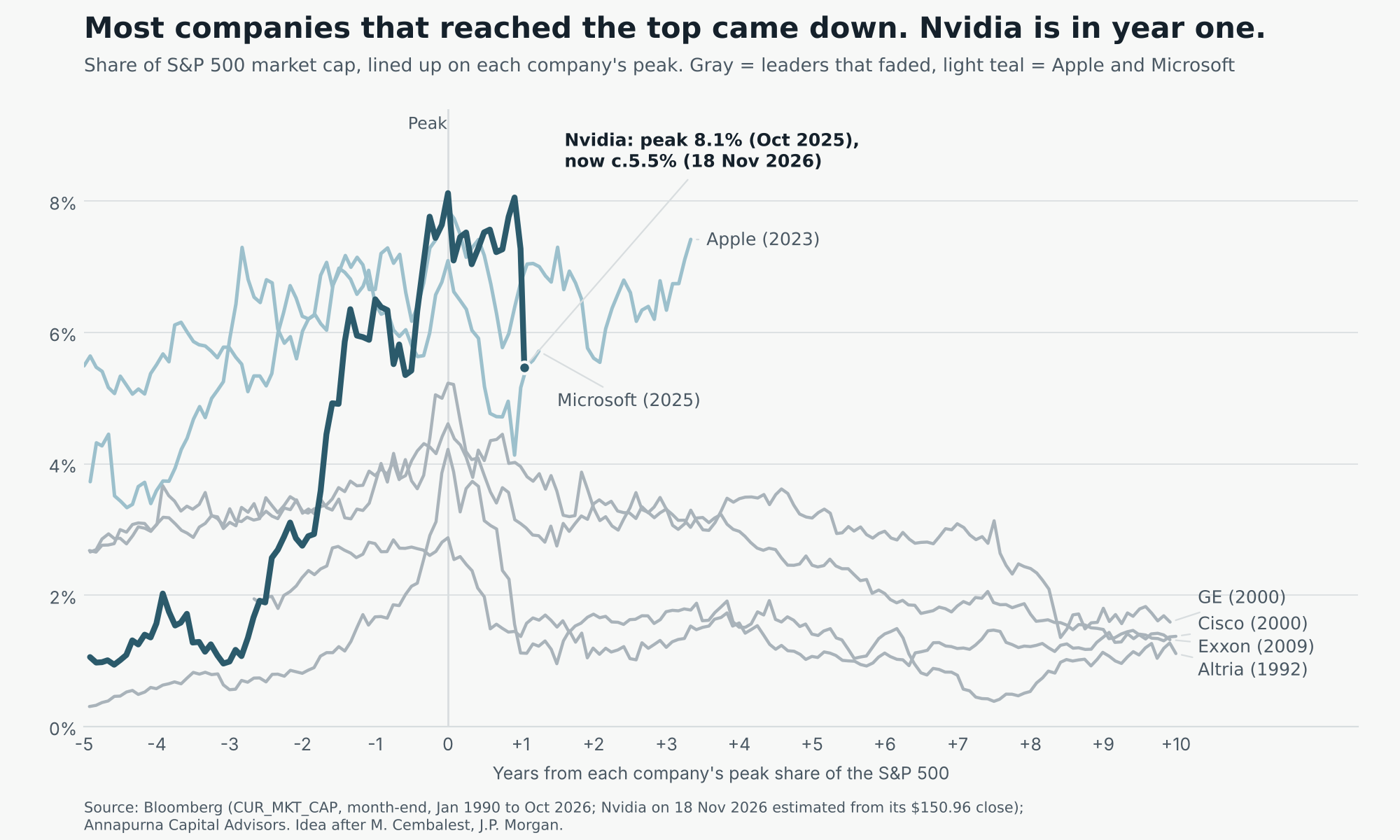
No company has reached the top of the S&P 500 faster than Nvidia: from about 1% of the index in late 2022 to 8% at its peak. It is now back near 5.5%. History is rarely kind to companies that get there. Cisco, GE, Exxon and Altria all fell back to 1–2% of the index within a decade of their peaks. Only Apple and Microsoft have held on—so far.
The bezzle arrives
The Huang affair dominated the headlines, but it was not really the story.
The facts about Megaspeed, Alice Huang and the alleged China links had been circulating for months. The New York Times wrote about the relationship in October 2025. Culper Research laid out the money trail in May 2026. Nvidia rose about 3% that day.
Then, within two weeks, it all came due.
| Date | What happened |
|---|---|
| 29 Oct | NYT reports US officials believe Alice Huang is a Chinese intelligence asset |
| 4 Nov | Three House committee chairs request a closed briefing |
| 6 Nov | NYT and FT report a US memo describing the relationship |
| 8 Nov | Huang admits the affair; the board says it has confidence in him |
| 9 Nov | A Commerce probe reportedly moves to the Justice Department |
| 11 Nov | NYT reports a second relationship, with an executive who reported to him; the board accepts Huang’s resignation |
| 16 Nov | Commerce and DOJ say the criminal case targets Megaspeed |
| 17 Nov | Huang says he would be honored to return; the board says it does not intend to bring him back |
I do not condone what he did. But the board did not need a crime to act. A relationship with a direct report is enough at many large companies; Intel’s Brian Krzanich resigned over one in 2018. A CEO who called a relationship “normal” on 29 October, then admitted an affair ten days later, had spent the board’s trust.
The deeper lesson is Galbraith’s bezzle. In good times, nobody audits closely. When money tightens, everybody does. The facts did not change between May and November. The market did.
The tide was going out, and Jensen was caught with his pants down.
The Bank of Nvidia
The romance that matters is not the one that filled the tabloids. It is Nvidia’s romance with its own customers.
Nvidia did not merely sell chips. It invested in buyers, guaranteed their loans and leases, and in some cases promised to buy back capacity they could not rent. It became supplier, investor, lender and backstop customer—often in the same transaction.
Money leaves Nvidia and returns as revenue. It works beautifully while money flows. It hurts on the way down. This is Galbraith’s Lesson #1 and Lesson #2 in one paragraph: leverage stacked on leverage, and money going round in a circle.
| Item (10-Q, quarter to 26 July 2026) | Amount |
|---|---|
| Supply and capacity commitments | $279B |
| Other purchase commitments | $87B |
| Commitments to buy unsold AI cloud capacity | $36B |
| Leases for third parties not yet commenced | $20B |
| SB Energy / OpenAI Ohio guarantee | Up to $105B |
| Other AI-cloud guarantees | $3.5B |
| Total commitments and guarantees | c.$530B |
| Balance-sheet liabilities | $91B |
The headline number is $530 billion. It is important to be precise: only about $118 billion of it is guarantees proper, mostly tied to the Ohio campus. The rest are supply contracts, capacity commitments and other obligations. But $279 billion of supply commitments—up from $119 billion in a single quarter—is still an enormous bet that the orders keep coming.
The off-balance-sheet commitments are nearly six times the debt on the balance sheet.
The human version is more revealing. According to the Wall Street Journal, Huang’s team offered credit support to young clouds and datacenter developers in exchange for revenue shares. Kress repeatedly asked how the guarantees were priced and what Nvidia earned for the risk. Huang reportedly called her “a deer in the headlights.”
Nvidia considered a $250 billion backstop for OpenAI’s Ohio campus. Kress cut it to $105 billion, signed in August, and then paused some deals.
To be fair, a guarantee costs Nvidia only if a customer fails. The company holds roughly $99 billion of equity stakes across 242 companies and remains financially strong. The risk is not insolvency. The risk is that part of its growth was self-funded—and that the person now running the company is the one who questioned it.
The $500 billion third-party financing platform announced in August with Apollo, BlackRock, Blackstone, Brookfield, Goldman and KKR remains mostly memoranda of understanding. Bloomberg reports that none are finalized, lenders want Nvidia to bear more than 25% of the risk, and the first deals have slipped to January.
The Bank of Nvidia is closing its doors—politely.
Kukur Tihar for the neoclouds
This year, Laxmi Puja and Kukur Tihar (Dog Worship Day) fell on the same day: a festival for the goddess of wealth, and a day to bless our dogs.
We garland them with marigolds, mark their foreheads with red tika and feed them the best meal in the house. They are honored as loyal companions and guardians of Yama’s gates. In the Rig Veda, Yama keeps two four-eyed dogs. In the Mahabharata, Yudhishthira refuses heaven without the dog that walked beside him. The dog, of course, is Dharma in disguise.
Markets have their own loyalty rituals.
For three years, the neoclouds received the same treatment from Nvidia: equity, allocations, guarantees and promises to buy back unsold capacity. In return, they stayed loyal. They bought Nvidia—mostly only Nvidia.
The festival lasts a day. The question now is: what will the dogs eat tomorrow?
| Company | Nvidia’s role | Pressure point |
|---|---|---|
| CoreWeave | c.$2B equity; up to $6.3B capacity buy-backs through 2032 | $35B debt; 2032 notes yield above 16% |
| Nebius | c.$2B investment | Cut revenue guidance to the low end |
| OpenAI | c.$30B invested; $105B Ohio guarantee | Raised c.$11B against a $30B+ target |
| Nscale | $1B convertible; up to $860M rent guarantee | Microsoft walked away from its UK deal |
| Firmus, SharonAI, GMI | Unsold-capacity buy-backs | Six-year terms |
| IREN | Customer | Microsoft reassessment |
I see three paths from here.
The strong get weaned rather than dropped. Kress has every reason to honor signed guarantees while slowing new ones. CoreWeave’s beat-and-raise, with the stock up 25% on the day, shows that better-capitalized names can still fund themselves—at a price.
The marginal names go to the bond market, which is already crowded. Roughly $37 billion of this year’s $80 billion in datacenter bonds was rated junk, more than four times last year’s total. Gartner expects 80% of neoclouds not to remain independent by 2030.
Consolidation. Hyperscalers, sovereign funds and private equity buy capacity at a discount. That is good for the GPUs already running and bad for the investors who paid full price for them.
Kress’s first report answered the demand question, for now. Q3 revenue was $115.8 billion against $109.1 billion expected; datacenter revenue was $107.6 billion. She guided Q4 to $130 billion and raised fiscal 2028 growth guidance to 75% from 70%.
But the sentence that mattered was this: Nvidia will be “rigorously evaluating future investments, commitments, and guarantees.”
That is the Bank of Nvidia closing its doors.
The funding crack
The demand is still there. Tokens, rental prices and hyperscaler budgets all still point upward. But part of the growth rate was financed by the seller, and that part now gets repriced.
Non-hyperscaler customers were about 45% of Nvidia’s datacenter revenue last quarter—$40.3 billion of $89.0 billion. That is the pool most exposed to a financing pull-back.
About 6.5GW of cluster deals are supported by Nvidia financing structures. Against roughly 50GW of datacenter capacity due online in 2027, that is about 13%. Only 2–3GW of 2027 capacity looks at risk from permits and power, though Morgan Stanley expects about 5GW of US projects to slip from 2028 into 2029.
| Scenario | Non-hyperscaler orders | Hit to datacenter revenue |
|---|---|---|
| Weaned | -10% | c.-5% |
| Base | -25% | c.-11% |
| Freeze | -50% | c.-22% |
The arithmetic is simple: the hit equals the 45% non-hyperscaler share multiplied by the fall in orders. It ignores share shifts to AMD and custom silicon, which take volume from Nvidia but not from TSMC or memory.
My current view is that we land between “Weaned” and “Base.” Tuesday’s guidance puts the next two quarters firmly in the first. The real test is 2028, where the cuts are deepest.
This is not yet a demand glut. H100 spot prices are up about 50% year on year, and one-year contracts are up 21% since March. Token volumes on OpenRouter are up 25 times this year. The problem is funding at the edge of the market, not usage at the core.
And when compute gets expensive, someone else is already singing a cheaper tune.
Deusi-Bhailo for tokens
On the evening of Laxmi Puja, we ate at my cousin Guddu’s new restaurant in Kathmandu. He had built an outdoor barbecue pit and a bar from old motorcycle parts. The choila was smoky and spicy, prepared the old Newari way, charred over fire.
Halfway through dinner, older men arrived with brass instruments, singing Deusi-Bhailo (traditional Tihar songs sung from house to house in exchange for blessings and small gifts). Then children arrived with boom boxes, choreographed dances and more songs.
Every house gives the singers a tip. They pool the money for card games after Bhai Tika, or for a collective trip.
Chinese AI models have spent the year doing something similar to the world’s developers—except they sing cheaper, and hand over the gifts themselves.
When compute becomes expensive, cheap tokens win. If Nvidia’s credit machine slows, the marginal US compute buyer pays more or waits. Chinese open models already serve tokens at a fraction of US list prices: DeepSeek V4.1 Flash lists at $0.15–0.30 per million input tokens, against several dollars for US frontier models.
They also already have the developers. Chinese models carried about 50% of OpenRouter tokens in late October, against 12% for US models, and have led for 26 straight weeks. The top five were all Chinese: DeepSeek, MiniMax, Zhipu and Tencent among them. OpenRouter is developer-heavy API traffic, not the whole market, but it is a useful leading indicator.
Sanctions leak, and scarcity breeds efficiency. Bloomberg reports that Moonshot rented 32 China-based Supermicro servers with Nvidia B300s this summer; earlier reporting described roughly 20,000 Nvidia GPUs leased through Alibaba Cloud. Washington spent the week worrying about one CEO’s private life while Chinese labs rented the newest American chips. That is the real China story.
But sanctions do cap scale. Epoch estimates Huawei’s 2026 Ascend output at about 1.5 million units, against 5.9 million for Nvidia—under 4% in H100-equivalents. China’s answer has been to do more with less.
Domestic chips are getting a second wind. Cambricon rose about 22% last week and MetaX 16%, as substitution plays.
It is not a one-way trade. Reports that Commerce is finalizing curbs on Chinese remote access to US cloud AI chips hit the sector hard: Alibaba fell 13.7% for the week, Tencent 7.9%, and newly listed Zhipu and MiniMax lost 15–18% in three days.
Still, for all the pain in the Chinese names last week, China looks like the obvious beneficiary of the funding crack. The scrutiny on high-end chips no longer stops at China’s border. It now reaches Southeast Asia and every other loophole—from rented servers in Malaysia to remote access from Singapore. With Democrats now in control of Congress, Washington is likely to turn more hawkish on sanctions, not less.
By one estimate, about a third of China’s AI compute by end-2027 will be US chips rented remotely, three-quarters of it in Southeast Asia. The Remote Access Security Act, which passed the House 369–22, would close that door, and Washington is also moving to ban Chinese datacenter equipment.
Every closed door pushes Beijing to build at home, and pulls Southeast Asia’s datacenter boom into the crossfire.
On a first screen, China’s AI builders and chip designers look frightful: young companies, making little or no money, screening very expensive. Investors seem to have left them for dead, and the charts look horrible.
But surely, I ask, does China have any choice but to double down? Every new curb, and now a scandal that ties Nvidia’s China sales to espionage, sends Beijing the same message: the age of relying on American compute is ending. Whether through patriotic speeches, policy directives, or plain old-fashioned funding, the attention—and the money—has to return. The third national chip fund alone is CNY344 billion (about US$52 billion), before local funds and state banks. A multiple looks very different when the state is both the anchor customer and the anchor investor.
With that attention should come better earnings, and more reasonable valuations.
I for one am looking hard at this space, and working with my EM client to find the best opportunities.
For us in Asia, the China opportunity is less “buy Chinese AI” and more “own the parts of China’s stack that sanctions make indispensable”: domestic chips, equipment and power. Be more selective on the model and cloud names that a remote-access rule can hit overnight.
Everyone wants a second brother
A few days into Tihar, my cousin Rekha invited us to her home for Bhai Tika (the brother-sister blessing, when sisters apply a seven-colored tika to their brothers’ foreheads and pray for their long life).
I nearly missed it. No taxis, no rides; Kathmandu’s streets were empty because everyone was home for their own tika. Eventually, my younger sister Ruby ferried me there on the back of her motorcycle.
It was my first Bhai Tika in Nepal in nearly three decades. My sisters applied the seven-colored tika, placed garlands of makhmali flowers around our necks, cracked walnuts and served yogurt as prasad (a blessed offering). The ritual comes from Yamuna, who bargained with Yama for her brother’s life: he could not take him until her tika faded, her oil dried and her flowers wilted. That is why the flower is makhmali—the flower that does not wilt.
A sister, outwitting death itself.
A brother is lucky to have one sister looking out for him. This year, every hyperscaler seems to want more than one brother.
Nvidia’s loosening financing grip is a gift to the alternatives. The market voted last Thursday: Nvidia fell 4.3%, while AMD rose 5.9% and Broadcom 5.5%. By that Friday, it was a full rotation within AI rather than out of it. Taiwan’s TAIEX had its best week on record, helped by the tenth activation of its NT$500 billion (about US$15 billion) stabilization fund. Global Unichip rose 38.8%; MediaTek rose 21.5%.
| Name | Why it gains | Watch-out |
|---|---|---|
| AMD | Merchant alternative to Nvidia GPUs; Q4 guide c.$17B (+66%); OpenAI among first Helios customers | Much of the move may already be positioning |
| Broadcom | Custom XPUs for Google, Anthropic, OpenAI and Meta; FY27 AI revenue c.$115B | It has its own vendor-financing loop |
| Alphabet | TPUs now sold outside Google; c.100 TPU customers | Building TPU inventory ahead of billing |
| Amazon | Trainium for AWS and, later, external customers | External sales are a 2027–28 story |
| SpaceX / xAI | Owns and rents compute; Google pays c.$920M/month | Google lease cancellable on 90 days’ notice |
Two cautions. First, vendor financing is not only an Nvidia habit: Broadcom, and even TSMC, are now writing checks to customers. Lessons one and two apply to the challengers too.
Second, inference is where the price war is. Cheaper chips plus cheaper models means more tokens—but thinner margins for whoever sells them.
The reckoning: policy cracks the buildout, financing cracks the edge
In Part 1, I argued that the first crack would come from policy: permits, power, grid connections, local resistance, and a voter backlash against datacenters. That crack has widened. Projects are slipping, capacity is being deferred, and the physical buildout is becoming slower and more expensive.
But policy was only ever half the story.
The second crack is financing. Galbraith’s Lesson #1 was leverage stacked on leverage. His Lesson #2 was money going round in a circle. Both are now arriving at once.
Nvidia did not merely sell chips. It invested in its customers, guaranteed their debts and leases, and promised to buy back capacity they could not rent. Money left Nvidia and returned as revenue. It was a beautiful loop—while the money kept flowing.
Now the loop is tightening.
The neoclouds that grew on Nvidia’s generosity are discovering that the Bank of Nvidia is closing for new business. CoreWeave’s 2032 notes yield more than 16%. Roughly $37 billion of this year’s $80 billion in datacenter bonds was rated junk—more than four times last year’s total. OpenAI raised about $11 billion against a target above $30 billion. The $500 billion Wall Street financing platform meant to replace Nvidia’s balance sheet remains mostly unsigned.
The marginal buyer of AI compute is no longer being financed on the old terms.
That does not mean AI demand vanishes. Tokens are still growing. Rental prices are still rising. Hyperscaler budgets are still expanding. But a meaningful slice of the boom was never organic demand. It was financed demand—demand created by vendor equity, guarantees, buy-backs, private credit and circular revenue.
When financed demand slows, capex slows. When capex slows, orders slow. And when orders slow, the revenue growth that justified the valuations begins to look less like a secular miracle and more like a credit cycle.
This is the point: the bubble is cracking from policy on one side and financing on the other. The first delays the datacenters. The second starves the smaller neoclouds that were supposed to fill them. Together, they threaten the capex flow that has been dragging US growth higher.
The macro question
So, does closing the Bank of Nvidia cause a US recession?
Not on its own. But it does not need to.
Nvidia’s money mostly funded the leveraged edge: neoclouds, junk-rated datacenter bonds, OpenAI’s Ohio campus. The hyperscalers pay from their own cash flow, and their 2027 budgets are still rising. But the marginal project—the one that needed vendor support, private credit, or a promise that unsold capacity would be bought back—now faces a harder market.
Add the policy squeeze, and the effect compounds. A datacenter is not just a purchase order. It is land, zoning, power, water, transformers, turbines, chips, financing and customers. Delay any link and the project slips. Delay enough projects, and capex stops growing before it falls.
Datacenter capex is on course to rise from 1.4% of US GDP in 2025 to about 3.1% in 2027—roughly 0.85 percentage points of GDP a year. A cycle that builds that fast can unwind quickly. Add a 10-year yield above 5% and a December hike, and growth slows sharply if capex merely stops growing.
And it will not stop at capex. The world is heavily long America: about 80% of global equity flows went into US stocks this year, and foreigners hold some $25 trillion of them. One estimate suggests a 25% fall in US stocks would cut US consumer spending by about 2%. For Asia, the twist is that much of the capex is imported chips and servers. If it unwinds, Taiwan and Korea may feel it before Ohio does.
Bottom line: the lamps stay lit, the credit does not
This week felt like Galbraith’s first two lessons arriving on schedule.
Demand remains. Tokens, rental prices and hyperscaler budgets still point up. But part of the growth was financed by the seller, and that part is being repriced. The man who built the loop is gone. The CFO who questioned it is running the company. The $500 billion of Wall Street money meant to replace the Bank of Nvidia’s lifeline has not signed a deal.
This is not a story of AI demand collapsing. It is a story of policy delaying the buildout while financing withdraws from the edge. The hyperscalers may keep spending. TSMC may keep shipping. But the neoclouds, junk bonds, guarantees and circular deals that turned a strong demand story into a credit-fueled capex boom are now being repriced.
Galbraith’s first two lessons have arrived together: leverage stacked on leverage, and money going round in a circle. The bubble is not bursting with a bang. It is being squeezed—from the permitting office, the power grid, the bond market, and the Bank of Nvidia’s own front door.
I started my career covering technology stocks during the dot-com boom in San Francisco. The tell then was Cisco’s order book: up 70% year on year in September 2000, down 30% by January 2001. Revenue eventually fell 37%; the stock fell 90%.
The AI capex boom is different in important ways. Today’s key companies are more profitable and better capitalized. Nvidia’s orders are still rising, and it looks inexpensive on earnings—assuming earnings are not slashed. But Cisco’s numbers looked fine too, until they did not.
Where to hide
Those of us who have lived through previous unwinds know how fast and painful they can be. Even on the way down, there are vicious pops and squeezes. Investors should stay invested—but selectively.
The second brothers: custom silicon and the TPU/ASIC chain—Broadcom, MediaTek, Global Unichip—over the Nvidia rack chain. AMD too, though its recent run already prices some of it.
China’s own ecosystem: domestic chips, equipment and power. The parts of the stack sanctions make indispensable.
Defensive Asia: India IT services, China internet and telecoms.
Mind Korea: it now trades as the AI-credit proxy, not the Nvidia proxy. SK Hynix barely tracks Nvidia week to week, but the KOSPI follows the neoclouds with a one-week lag and a correlation near 0.9. If a neocloud cracks, Korea feels it through flows—whatever Nvidia reports.
The lamps are still lit. The credit is not.
Good luck out there… and please wear a helmet.
Sources
Nvidia 8-K, CEO transition (11 Nov 2026); press release; 10-Q, quarter to 26 July 2026; SB Energy release.
WSJ, “Before His Ouster, Jensen Huang Belittled the Executive Replacing Him” (13 Nov).
Fortune (11 Nov); TechCrunch (12 Nov).
Hunterbrook (6 Nov); AIR Platforms (12 Nov); RCR Wireless (13 Nov).
Forbes, neocloud debt (16 Oct); 247WallSt, OpenAI raise; Korea JoongAng Daily.
Yahoo Finance (12 Nov close); StockAnalysis NVDA history.
Focus Taiwan; Business Standard / Acadian; TSMC October sales.
Caixin via Dealroom, OpenRouter share; Epoch AI, Huawei roadmap; FourWeekMBA, China AI moves; 247WallSt, remote-access curbs.
AMD Q3 release; Broadcom Q3 FY26 call; Google TPU 8tx; Amazon Trainium; DCD, Google-SpaceX lease.